

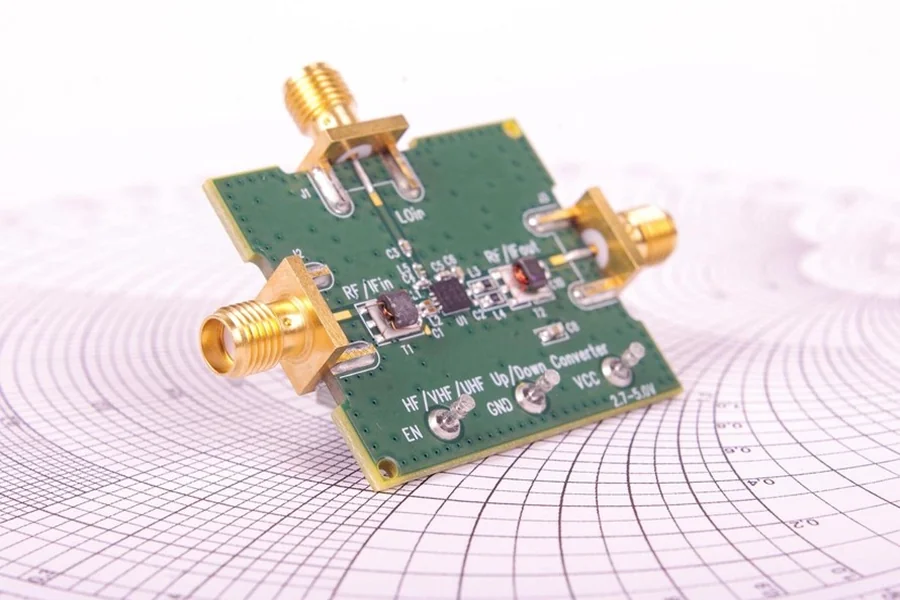
An RF PCB board, or Radio Frequency printed circuit board, is specifically designed to operate at high frequencies, typically from 300 kHz to 300 GHz. These boards are engineered to ensure minimal signal loss, stable impedance control, and excellent electrical performance in high-speed and high-frequency environments.
Unlike standard PCBs, RF PCB boards use specialized materials and fabrication techniques to handle sensitive RF signals without interference. They are essential in modern communication systems, radar applications, satellite equipment, and advanced electronics where signal clarity and reliability are critical.
Key Materials Used in RF PCB Board
The choice of material is one of the most critical factors in the performance of an RF PCB board. While standard PCBs often use FR4 substrates, RF PCB boards typically employ advanced laminates such as PTFE (Teflon), Rogers, Isola, or Taconic materials. These substrates offer low dielectric constant (Dk) and low dissipation factor (Df), which help reduce signal loss and distortion.
Additionally, the copper used in RF PCB boards is often treated for smoother surfaces to minimize conductor losses. The material selection depends on the specific frequency range, power requirements, and environmental conditions of the application.
Design Features of RF PCB Board
Designing an RF PCB board requires precise control over impedance, signal routing, and dielectric properties. Common features include:
- Controlled impedance traces for maintaining signal integrity.
- Minimized via count to prevent signal reflection and loss.
- Shorter signal paths to reduce delay and interference.
- Carefully managed grounding and shielding for noise reduction.
The use of microstrip, stripline, or coplanar waveguide structures in the design ensures that RF signals travel efficiently without degradation.
Benefits of RF PCB Board
The primary advantage of an RF PCB board is its ability to handle high-frequency signals with minimal distortion. Some key benefits include:
- Low signal loss for enhanced performance in communication systems.
- Stable electrical characteristics across a wide temperature range.
- High precision in impedance control for consistent performance.
- Durability in harsh environments, such as aerospace or military applications.
These boards are vital for ensuring the reliability and efficiency of devices that depend on rapid and accurate signal transmission.
Applications of RF PCB Board
RF PCB boards are used in a variety of industries where high-frequency signal transmission is essential. Common applications include:
- Telecommunication equipment such as 5G base stations and satellite communication devices.
- Radar and navigation systems used in aviation, defense, and marine sectors.
- Medical imaging equipment like MRI and CT scanners that require precise signal control.
- Wireless networking devices, including Wi-Fi routers and IoT modules.
As technology advances, RF PCB boards are also becoming integral in emerging applications like autonomous vehicles, wearable electronics, and smart infrastructure.
Manufacturing Challenges of RF PCB Board
Producing an RF PCB board involves several challenges due to its specialized nature. Precision is key, as even slight variations in trace width or dielectric thickness can impact performance. Manufacturers must use advanced equipment for drilling, plating, and etching to achieve the required tolerances.
Temperature control during manufacturing is also important to prevent material deformation, which could alter electrical properties. Additionally, surface finishes like ENIG (Electroless Nickel Immersion Gold) or immersion silver are often used to maintain excellent conductivity and solderability.
Design Considerations for RF PCB Board
When designing an RF PCB board, engineers must consider several factors:
- Dielectric constant consistency to ensure predictable signal behavior.
- Signal isolation to avoid cross-talk between high-frequency traces.
- Power handling capability to prevent overheating during operation.
- Component placement to minimize interference and optimize signal flow.
Simulation tools are often used to model performance before fabrication, ensuring that the final design meets all electrical and mechanical requirements.
Future Outlook for RF PCB Board Technology
The demand for RF PCB boards is expected to grow significantly with the rise of 5G, satellite internet, IoT, and advanced radar systems. Future developments may include the use of ultra-low-loss materials, embedded components, and additive manufacturing techniques to improve performance while reducing costs.
As devices become smaller yet more powerful, RF PCB board technology will continue to evolve to meet the requirements of next-generation communication and sensing systems.
Choosing the Right RF PCB Board Manufacturer
Partnering with an experienced rf pcb board manufacturer is crucial to achieving the desired performance in your high-frequency applications. A skilled rf pcb board manufacturer will have expertise in selecting the right materials, controlling impedance, and using advanced fabrication methods to meet strict tolerances. They can also provide valuable design support and testing services to ensure your product performs reliably in real-world conditions. By working with the right rf pcb board manufacturer, you can ensure your devices operate with the highest efficiency, durability, and signal integrity.
