

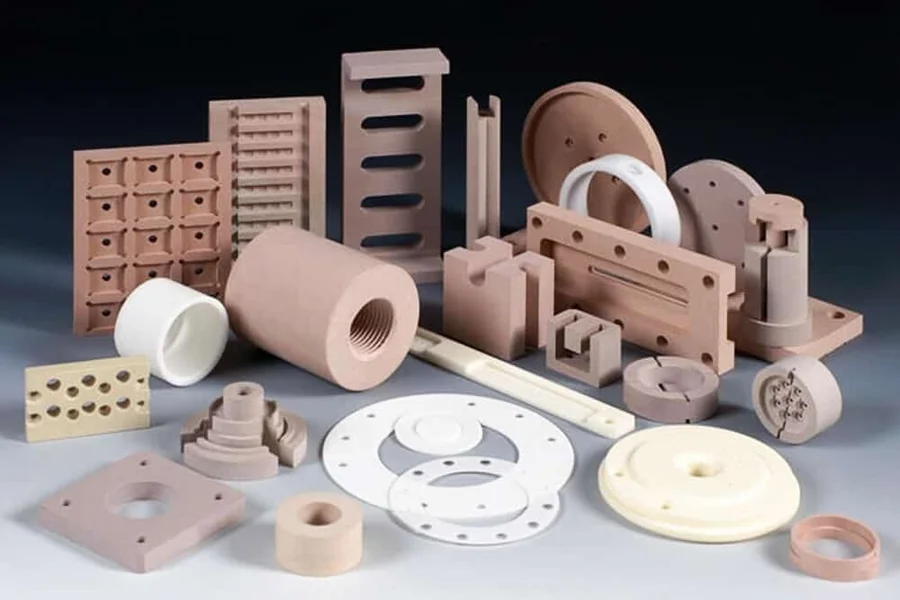
Traditional ceramics are among the oldest materials engineered by humankind, known for their incredible heat resistance and hardness. However, they have always had a significant weakness: they are brittle. Like a dinner plate dropped on a tile floor, monolithic ceramics tend to shatter catastrophically under stress. This brittleness has historically limited their use in high-impact, load-bearing applications where failure is not an option.
But what if you could combine the phenomenal heat and wear resistance of ceramics with the toughness of other materials? This is the core idea behind composite ceramics. These advanced materials are engineered to overcome the inherent fragility of their monolithic counterparts, opening the door to a new era of performance in some of the world’s most demanding industries. From jet engine turbines to high-performance brakes and cutting-edge body armor, composite ceramics are making the impossible possible.
This guide will provide a complete overview of these remarkable materials. We will explore what they are, how they are made, and the unique properties that make them so valuable. Whether you are an engineer, a researcher, or simply a curious enthusiast, you will gain a clear understanding of why composite ceramics are at the forefront of materials science.
What Are Composite Ceramics?
At its simplest, a composite is a material made from two or more constituent materials with significantly different physical or chemical properties. When combined, they produce a material with characteristics different from the individual components.
Composite ceramics are a class of these materials where at least one of the main components is a ceramic. The goal is to create a new material that retains the desirable properties of ceramics—like high-temperature stability and wear resistance—while improving upon their major weakness: low fracture toughness (brittleness).
The structure of a composite consists of two main parts:
- The Matrix: This is the bulk material that encloses and binds the reinforcement. In composite ceramics, the matrix is ceramic.
- The Reinforcement: This is the material added to the matrix to improve its properties. The reinforcement can take the form of particles, whiskers, or fibers.
The magic of composite ceramics happens at the interface between the matrix and the reinforcement. When a crack starts to form in the brittle ceramic matrix, its path is interrupted by the reinforcement phase. The reinforcement can deflect the crack, bridge it, or absorb its energy, preventing the catastrophic failure that would occur in a standard ceramic.
Types of Composite Ceramics
Composite ceramics are typically categorized based on the type of matrix material. The two most prominent families are Ceramic Matrix Composites (CMCs) and Metal Matrix Composites (MMCs) with ceramic reinforcement.
Ceramic Matrix Composites (CMCs)
CMCs are the “purest” form of composite ceramics, consisting of a ceramic matrix reinforced with ceramic fibers, whiskers, or particles. The goal here is to introduce toughness while retaining the ultra-high temperature capabilities of ceramics.
- Reinforcement: The most common reinforcements are silicon carbide (SiC) or carbon (C) fibers. These long fibers are incredibly strong and can stop cracks from propagating through the matrix.
- Matrix: The matrix is also typically a ceramic like silicon carbide or a ceramic oxide.
- Key Feature: CMCs are lightweight and can withstand extreme temperatures (often above 1,200°C) far better than even the most advanced metal superalloys. This makes them game-changers for aerospace applications.
- Example: A SiC/SiC composite, where silicon carbide fibers are embedded in a silicon carbide matrix, is used for hot-section components in jet engines.
Metal Matrix Composites (MMCs)
While the matrix is metal (like aluminum, magnesium, or titanium), these composites are often grouped with composite ceramics because they use ceramic particles or fibers as reinforcement to enhance performance.
- Reinforcement: The ceramic reinforcement, often in the form of particles like silicon carbide or alumina, is added to the metal matrix.
- Matrix: A lightweight metal like aluminum.
- Key Feature: MMCs are not designed for the same extreme temperatures as CMCs. Instead, their purpose is to increase the stiffness, strength, and wear resistance of a lightweight metal without significantly increasing its weight.
- Example: Aluminum reinforced with silicon carbide particles is used for high-performance automotive brake rotors. The ceramic particles provide superior wear resistance and heat management compared to standard cast iron.
Key Properties and Advantages
The engineering behind composite ceramics results in a material with a unique and highly desirable set of properties.
1. High Fracture Toughness
This is the single most important advantage. By incorporating a reinforcement phase, composite ceramics can absorb fracture energy, making them far more resistant to cracks and impact. They exhibit “graceful failure,” meaning they can sustain some damage without shattering completely, a critical safety feature for structural components.
2. Extreme Temperature Stability
CMCs, in particular, retain their strength and structural integrity at temperatures that would cause even advanced nickel-based superalloys to melt or creep. This allows for the design of more efficient engines and industrial processes that can run hotter.
3. Low Density (Lightweight)
Composite ceramics are significantly lighter than the high-temperature metals they often replace. For example, CMCs are typically one-third the weight of their superalloy counterparts. This weight reduction is a massive benefit in the aerospace industry, leading to improved fuel efficiency and payload capacity.
4. High Wear and Corrosion Resistance
The inherent hardness and chemical inertness of the ceramic matrix give these composites excellent resistance to abrasive wear, erosion, and chemical corrosion, extending the service life of components in harsh environments.
Real-World Applications
The unique properties of composite ceramics have made them essential materials in several high-tech sectors.
Aerospace and Defense
- Jet Engines: CMCs are being used to manufacture hot-section components like turbine shrouds, combustor liners, and nozzles. These parts run hotter, last longer, and are lighter than metal parts, leading to more fuel-efficient and powerful engines.
- Thermal Protection Systems: The nose cones and leading edges of hypersonic vehicles are subjected to incredible heat upon atmospheric reentry. Composite ceramics like Carbon-Carbon (C-C) composites are used to handle these extreme thermal loads.
- Body Armor: The hardness of ceramics makes them ideal for stopping high-velocity projectiles. Composite armor plates often feature a ceramic strike face backed by a polymer composite layer to absorb the impact energy.
Automotive Industry
- Brake Systems: High-performance sports cars and luxury vehicles use brake discs made from Carbon-Ceramic Matrix Composites. These brakes are lightweight, resistant to fade at high temperatures, and have a much longer lifespan than traditional iron discs.
- Engine Components: MMCs with ceramic reinforcement are used for components like pistons and cylinder liners to reduce weight and improve wear resistance.
Energy and Industrial
- Gas Turbines for Power Generation: Similar to jet engines, land-based gas turbines use CMC components to increase operating temperatures and improve electrical generation efficiency.
- Industrial Furnaces: Components like radiant burner tubes and kiln furniture made from composite ceramics can withstand harsh chemical environments and high temperatures for longer periods.
Frequently Asked Questions (FAQs)
Q: Are composite ceramics expensive?
A: Yes, currently, composite ceramics are significantly more expensive to manufacture than traditional metals or monolithic ceramics. The raw materials are costly, and the multi-step manufacturing processes (like chemical vapor infiltration) are complex and time-consuming. However, for applications where performance is critical, the cost is justified by improved efficiency and longer component life.
Q: How are composite ceramics made?
A: The manufacturing process is complex and varies by type. For CMCs, a common method involves creating a preform of woven ceramic fibers. The ceramic matrix is then infiltrated into this preform, either through a polymer precursor that is later pyrolyzed into a ceramic, or through a gas-phase process called Chemical Vapor Infiltration (CVI).
Q: What is the main difference between a CMC and a cermet?
A: Both are composites, but the roles are reversed. In a Ceramic Matrix Composite (CMC), the matrix is ceramic and is reinforced by fibers. In a cermet (a portmanteau of “ceramic” and “metal”), the primary component is ceramic (like tungsten carbide), and a smaller amount of metal (like cobalt) acts as a binder or “glue.” Cermets are known for extreme hardness and are used for cutting tools.
Q: Can composite ceramics be machined?
A: Machining fully densified composite ceramics is extremely difficult and expensive due to their hardness. They typically require diamond-tipped tools. As a result, components are often manufactured to “near-net shape” to minimize the amount of final machining required.
Final Words
Composite ceramics represent a monumental leap forward in materials science. By cleverly combining materials to create a whole greater than the sum of its parts, engineers have successfully overcome the age-old problem of ceramic brittleness. These materials are no longer confined to the laboratory; they are actively powering the next generation of aircraft, enabling faster and safer transportation, and pushing the boundaries of energy efficiency.
While cost and manufacturing complexity remain challenges, ongoing research and development are continuously making composite ceramics more accessible. As we continue to demand lighter, stronger, and more heat-resistant materials, there is no doubt that these engineered composites will play an increasingly vital role in shaping the technology of the future. They are a testament to the power of innovation, proving that even a material’s greatest weakness can be transformed into a source of strength.
